Retaining Wall Drainage: Why Walls Fail and How to Fix It
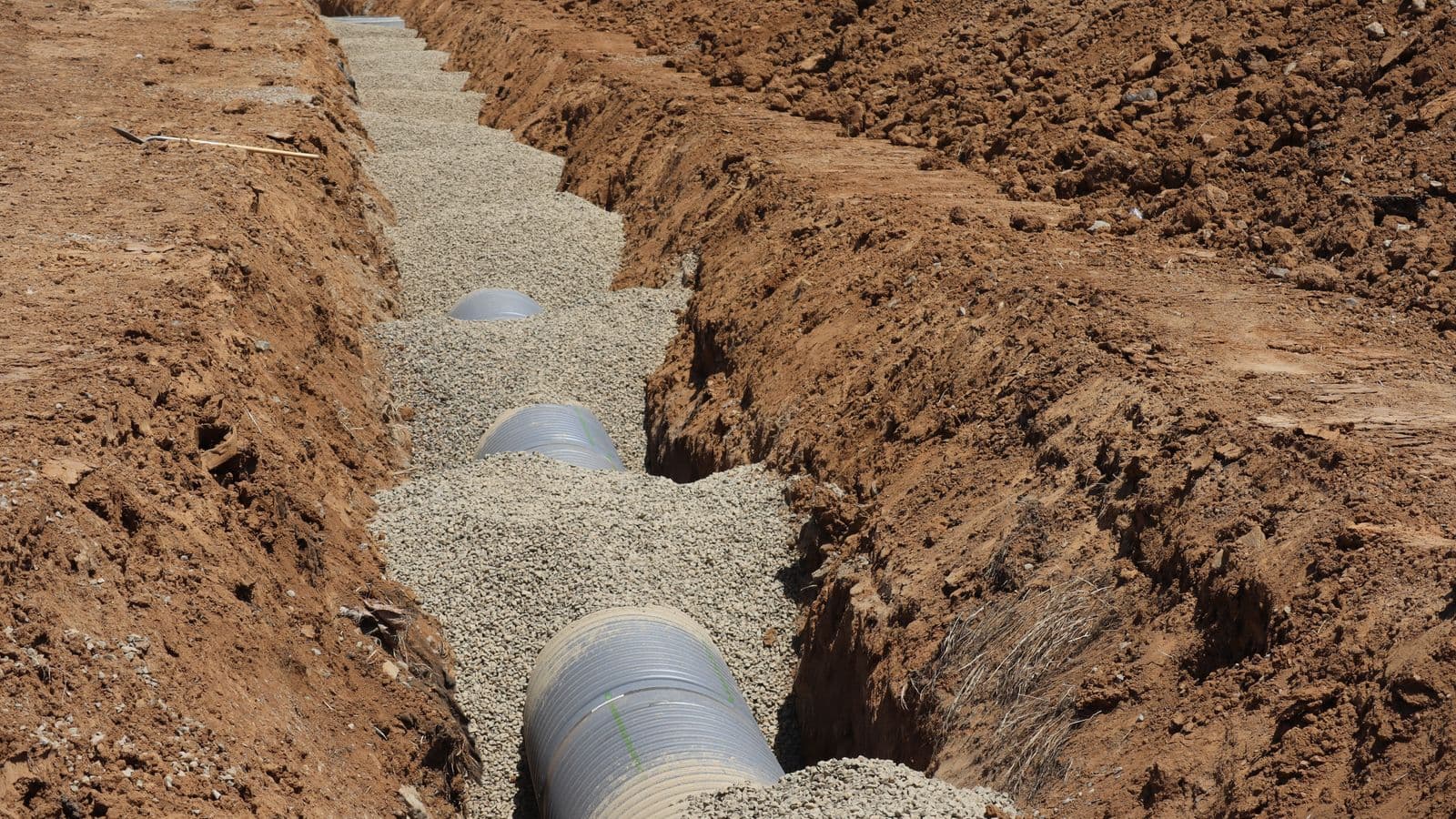
Water is patient. It doesn't need drama to wreck a retaining wall — it just needs somewhere to sit. Every year, homeowners call a contractor about a bulging wall, a cracked block, or a section that's leaning further than it did last spring, and the cause is almost always the same: retaining wall drainage that was skipped, undersized, or clogged. This guide breaks down why water does so much damage, exactly what a proper drainage system looks like layer by layer, and the mistakes that quietly turn a well-built wall into next year's repair bill.
- Trapped water, not soil weight, causes most retaining wall failures — saturated backfill can roughly double the load a wall was designed to hold.
- A working system needs three parts together: a 12-inch column of clean ¾" drain rock, a 4" perforated pipe daylighted to open air, and filter fabric wrapping the rock.
- Water weighs 62.4 pcf. Saturated clay backfill can weigh well over 120 pcf, compared to roughly 100-110 pcf when it's merely damp.
- Segmental retaining wall guidance from the National Concrete Masonry Association treats internal drainage as a core design requirement, not an optional extra.
- Weep holes are a backup path through solid concrete or masonry faces — they don't replace drain rock and pipe behind the wall.
- Undrained walls typically show bulging, staining, or slumping within two to five years, well short of the 30-50 year lifespan a properly drained wall should hit.
Why water is the enemy
Every stability calculation your wall design relies on — sliding resistance, overturning resistance, bearing pressure — assumes the backfill behind the wall is roughly at its normal moisture content. Water breaks that assumption in two separate ways.
First, standing water adds hydrostatic pressure directly against the back face of the wall. Water weighs 62.4 pounds per cubic foot, which is heavier than most native soils in their compacted, dry state. A wall built to resist soil pressure alone has no reserve capacity left over for water pressure on top of it.
Second, saturated soil loses shear strength. Wet clay in particular turns soupy and slumps against the wall instead of standing on its own, which is one of the reasons soil and backfill choice matters as much as the wall itself. A free-draining granular backfill sheds water quickly; a dense clay backfill holds it like a sponge and keeps pushing.
Put both effects together and you can roughly double the load the wall was engineered for — which is exactly why most retaining wall failures trace back to water rather than to a wall that was simply too thin or too short.
Hydrostatic pressure, explained simply
Hydrostatic pressure increases in a straight line with depth. It doesn't matter whether the water came from rain, an uphill spring, a leaking downspout, or irrigation — once it's trapped against the wall, the pressure at any given depth is the same.
| Depth of trapped water | Hydrostatic pressure at that depth |
|---|---|
| 2 ft | ~125 psf |
| 4 ft | ~250 psf |
| 6 ft | ~375 psf |
| 8 ft | ~500 psf |
For context, that pressure is added on top of whatever the soil itself is already pushing. A wall designed with a healthy factor of safety against dry soil pressure can still fail once even a couple of feet of standing water builds up behind it.
"Internal drainage is not a finishing touch on a segmental retaining wall — it's part of the load path the whole design depends on." — Slopeify's engineering advisors
That's also why design guidance for segmental walls typically assumes a worst-case groundwater scenario rather than a best-case one, and sizes the wall (or specifies drainage) to keep water from ever reaching that worst case in practice.
The full drainage system, component by component
A proper drainage system isn't one product — it's three or four parts working as a team, plus a base that doesn't undo the rest of the work.
Drain rock: a 12-inch-wide column of clean ¾" angular stone runs the full height of the wall, directly behind it. Angular stone matters here — rounded pea gravel packs together and drains poorly compared with crushed, angular rock, which locks together while leaving plenty of void space for water to move through.
Perforated pipe: a 4" perforated pipe sits at the base of the drain rock, sloped at a minimum of about 1% so water actually moves rather than pooling. It needs to run to daylight — an open outlet on a slope — or to a storm drain, sump, or dry well. A pipe with nowhere to discharge is just an underground reservoir.
Filter fabric: a non-woven geotextile wraps the drain rock column, keeping fine soil particles out while letting water through. Skip this and the voids in the rock silt up within a few seasons, quietly turning a drainage system back into a clay backfill.
Weep holes: for solid concrete or masonry-faced walls, weep holes every few feet through the face give water a second way out if the main system gets overwhelmed. They're a backup, not a substitute.
| Component | Typical spec | Rough material cost |
|---|---|---|
| Drain rock (¾" clean, angular) | 12 in wide, full wall height | $45-$65 per ton, delivered |
| Perforated pipe (4") | Sloped ≥1% to daylight or drain | $1-$3 per linear ft |
| Non-woven filter fabric | Wraps rock, 12 in overlap | $0.25-$0.50 per sq ft |
| Weep holes | 1-2 in dia., every 4-8 ft | Built into unit cost |
| Crushed stone leveling pad | 6-12 in, compacted | $30-$50 per ton, delivered |
Don't forget the base. A compacted crushed-stone leveling pad under the wall spreads the load evenly across the foundation soil and gives water somewhere to go instead of pooling under the footing, where it can undermine footing depth decisions and lead to frost heave in colder climates. Our calculator includes drain rock, pipe, and fabric in every materials list for exactly this reason — it's not an add-on, it's part of a working wall.
Common drainage mistakes (and how to fix them)
Most drainage failures aren't caused by using the wrong materials — they're caused by small installation shortcuts that seem harmless at the time.
- Pipe with no outlet. A perforated pipe that dead-ends against a hillside or gets buried under a paver patio just fills up. Fix: always confirm the pipe daylights somewhere, and check that outlet twice a year for blockages.
- Fabric wrapped too tight or skipped entirely. Compressing the fabric against the rock defeats the point, and skipping it lets soil migrate in within a season or two. Fix: wrap loosely, overlap seams by at least 12 in, and never backfill drain rock without it.
- Backfilling with on-site clay instead of drain rock. It's tempting to reuse the dirt that came out of the excavation, but if it's clay-heavy, it holds water rather than shedding it. Fix: haul it away and bring in clean, angular fill.
- Flat or backward-sloped pipe. A pipe laid dead level, or one that unintentionally slopes the wrong way, won't move water at all. Fix: check slope with a level during installation, not after backfilling.
- Relying on weep holes alone. They help, but they can't move the volume of water that drain rock and pipe can. Fix: treat weep holes as a backup, not the whole plan.
- Ignoring surface water. Downspouts, sprinkler heads, and poorly graded lawns can dump more water at a wall than any drainage system was sized for. Fix: route roof and surface runoff away from the wall before it ever reaches the backfill.
If you're unsure whether an existing wall has any of these problems, checking your local soil type on the USDA's Web Soil Survey is a useful first step — heavy clay soils in your area are a strong hint that drainage deserves extra attention.
Drainage for different wall types
Not every wall drains the same way, and the differences matter.
Segmental block (SRW) walls rely on the open-graded gravel inside and behind the units, which does double duty as both compaction aid and drainage path. This is the system most homeowner block-wall designs assume by default.
Poured concrete and CMU walls are solid, so weep holes through the face matter more here than on a block wall, since there's no naturally porous unit structure to lean on. Drain rock and pipe behind the wall still do most of the work.
Timber and sleeper walls fail differently — trapped moisture rots the timber itself rather than just adding pressure, so drainage here is as much about wood longevity as wall stability.
Walls on a slope often have water arriving from upslope as well as from directly above, so a French drain or swale intercepting that water before it reaches the wall matters as much as the wall's own drainage system — see our guide on building on a slope for the grading details.
A wall that failed within two years
A homeowner in Ohio built a 4 ft block wall to level a sloped backyard, using on-site clay to backfill instead of drain rock, to save on hauling costs. There was no perforated pipe, and the two weep holes in the base course were the only path water had out. By the second winter, freeze-thaw cycles in the saturated clay had pushed the top of the wall nearly 3 inches out of plumb, and by spring a 10 ft section had visibly bulged.
The fix cost more than doing it right the first time would have: excavating behind the wall, installing proper drain rock and pipe, and resetting the bulged blocks. It's a common enough story that it's worth checking your local frost depth and drainage requirements — cold, wet regions see enough freeze-thaw cycling that undrained backfill is a near-guarantee of movement, not just a risk.
Get the drainage right the first time and there's very little else that goes wrong with a well-built wall. It's a modest line item against the total cost of the project, and it's the difference between a wall that quietly does its job for decades and one you're rebuilding before the mortgage is paid off.
FAQs
How do I know if my retaining wall has a drainage problem?
Look for water seeping or dripping from the face after rain, efflorescence (white mineral staining), bulging or leaning sections, and cracks that widen after wet weather. Standing water at the base of the wall or a consistently soggy area just uphill are also strong warning signs.
Do all retaining walls need a drain pipe?
Very short walls under about 2-3 ft with free-draining sandy backfill and no upslope water source can sometimes get by with drain rock alone, but any wall retaining more than that, or sitting in clay soil, should have a perforated pipe. It's cheap insurance relative to the cost of a rebuild.
Can I add drainage to an existing wall without rebuilding it?
Sometimes. Adding weep holes to a solid concrete or masonry wall, improving surface grading, and installing a French drain just uphill of the wall can all help without full excavation. Retrofitting drain rock and pipe behind the wall itself usually means excavating behind it, so it's worth getting a local contractor to assess whether that's necessary.
How much does retaining wall drainage add to the cost?
Drain rock, pipe, and fabric typically add a modest percentage to overall materials cost — often less than the cost difference between two grades of facing block. It's one of the cheapest parts of the project relative to how much failure risk it removes.
What's the difference between weep holes and a drain pipe?
Weep holes are small openings through the face of a solid wall that let water escape directly outward. A drain pipe runs along the base of the drain rock behind the wall and carries water away to a proper outlet. Weep holes handle overflow; the pipe is meant to handle the bulk of the flow.
Base width, factors of safety, materials and cost, all free.